

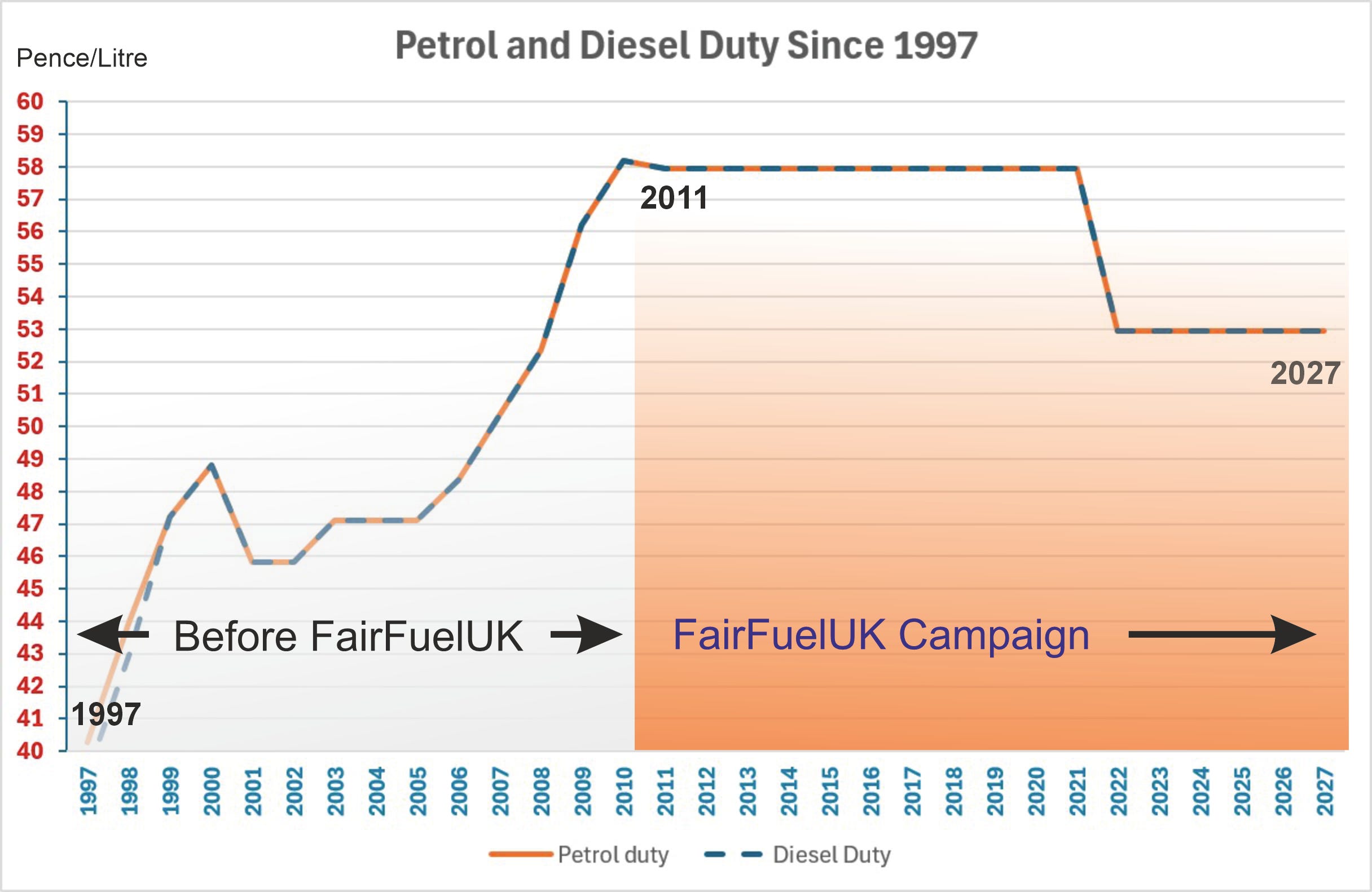
I came across this graph and found myself staring at it for quite a while.
Perhaps that’s because I’ve spent so much of the last 16 years talking about Fuel Duty that I know the individual Budgets, announcements, threatened increases, freezes and cuts almost by heart. But when you put the whole story onto one graph, something rather striking happens.
Look at the period before 2011.
There are ups and downs, but the long-term direction is unmistakable. Fuel Duty rises from around 40p per litre in 1997 to nearly 59p by the beginning of the last decade.
Then look at what happens afterwards.
The line stops climbing.
It stays almost completely flat for more than a decade. Then, in 2022, it actually falls with the 5p Fuel Duty cut. That’s Rishi Sunak’s 5
That dividing line around 2011 is significant to me because it was also the beginning of the FairFuelUK campaigning era.
“FUEL DUTY KEPT RISING. FAIRFUELUK ARRIVED. IT STOPPED.”
I’m well aware that saying that will invite accusations of claiming too much credit, so let me be clear about what I mean.
No campaign dictates what a Chancellor puts in a Budget. Governments make those decisions and there are always many economic, political and electoral factors involved.
But campaigns can change the environment in which those decisions are made.
And I believe that is what FairFuelUK helped to do.
Before our campaign, there was certainly no shortage of people concerned about motoring costs. The established motoring organisations existed. The haulage and freight groups existed. Newspapers covered fuel prices and MPs regularly heard from constituents struggling with the cost of filling up.
But despite all that, look at the left-hand side of the graph.
Fuel Duty kept rising.
What FairFuelUK brought was something different. It was a campaign focused relentlessly on Fuel Duty, built around mobilising the people who actually paid it and ensuring their concerns were heard in Westminster.
The breakthrough in 2011 was significant. In the March Budget, the planned increase was cancelled and Fuel Duty was cut by 1p per litre. [telegraph.co.uk]
Later that year, Robert Halfon spoke in the House of Commons about the scale of the campaign surrounding fuel prices. He referred to 116 MPs supporting his motion, 110,000 people signing an e-petition, newspaper campaigning and FairFuelUK, which he described as“one of the leading campaigners for lower petrol prices”. [parallelpa...ment.co.uk]
I think that moment tells us something important about how campaigning works.
There is sometimes a tendency to separate the work of campaigners from the parliamentary or media pressure that follows. In reality, they feed each other. A driver writes to an MP. The MP starts asking questions. The issue receives media attention. More people become involved. Ministers realise the issue isn’t going away.
That was what we wanted to achieve.
Our job was never to pretend we could write the Budget ourselves. It was to make sure the arguments and experiences of drivers reached those who did.
And then, crucially, to keep doing it.
I think persistence is probably the most important part of the FairFuelUK story.
A freeze in one Budget never meant there wouldn’t be a threatened rise in the next. So we kept making the case, gathering evidence from drivers and businesses, working with supportive MPs and putting the consequences of higher Fuel Duty in front of Ministers and the media.
Governments changed. Chancellors changed. Prime Ministers changed.
The argument carried on.
And that brings me back to the graph.
I don’t present it as scientific proof that FairFuelUK was single-handedly responsible for every Fuel Duty decision since 2011. That would be too simplistic.
But nor do I think it is credible to suggest sustained campaigning had no effect.
The contrast is simply too interesting to dismiss.
Before the FairFuelUK era, despite decades of established motoring organisations and media scrutiny, the long-term trend was upwards.
Then a dedicated Fuel Duty campaign emerged, public and parliamentary pressure intensified, and the upward trajectory stopped.
Eventually the rate went down.
“WE NEVER WROTE THE BUDGETS. WE JUST MADE SURE THE PEOPLE WHO DID COULD HEAR BRITAIN’S DRIVERS.”
That’s probably a better description of what we’ve tried to do over all these years.
There have been plenty of frustrating moments. Plenty of occasions when Governments appeared determined to increase the tax and plenty when the Treasury arguments seemed immovable.
But people kept responding.
Drivers wrote to MPs. Businesses told us what another increase would mean for their costs. Hauliers explained the knock-on consequences for everything they carry. Farmers, tradespeople and rural communities reminded Westminster that driving is often a necessity, not a choice.
Those voices mattered far more than any one campaigner ever could.
I’ve simply tried to make sure they were heard.
And they are still being heard. Ahead of the October 2026 Budget, more than 30,000 motorists, families, small-business owners, tradespeople, farmers and hauliers contacted the Prime Minister and Chancellor within 24 hours as part of a FairFuelUK campaign. [atvtoday.co.uk]
When I see numbers like that, what strikes me isn’t an opportunity to claim another campaigning victory. It’s the fact that, after all these years, so many people still feel strongly enough about this issue to do something.
Because Fuel Duty isn’t really about Fuel Duty.
It’s about how much it costs someone to get to work. It’s about the tradesperson who has to put diesel in a van before earning a penny that morning. It’s about the haulage company moving the goods on supermarket shelves and the farmer producing our food. It’s about the businesses that ultimately have to pass higher transport costs on to their customers.
And it’s about millions of people outside the big cities for whom the suggestion that they should simply drive less bears little resemblance to everyday life.
That is why keeping pressure on Fuel Duty has mattered.
Not because FairFuelUK needs another campaigning trophy to put on the wall.
Because these decisions affect real people.
So when I look at this graph, I don’t really see it as a monument to FairFuelUK.
I see something much more important.
I see evidence that decisions which can appear inevitable aren’t necessarily inevitable at all.
Public pressure matters. Parliamentary pressure matters. Media scrutiny matters. Persistence matters.
And ordinary people joining those things together can make politicians think again.
That’s what I hope FairFuelUK has contributed over the last 16 years.
I’ll leave others to decide precisely how much credit the campaign deserves. But I’d ask anyone looking at the graph to consider one question.
Why did the relentless upward trajectory stop around the time Britain’s drivers became organised around a dedicated campaign to stop it?
Perhaps there are several answers.
But after 16 years spent close to this issue, I don’t believe campaigning can honestly be excluded from them.
And that is why the work continues.
Not to celebrate what has already happened, but because the pressure to tax motorists more has never disappeared.
The next battle will come, as it always does.
And when it does, our job remains remarkably simple.
Make sure Britain’s drivers are heard.
THE RISE STOPPED WHEN FAIRFUELUK STARTED.
I’ll let the graph do the boasting.